Statutory registers, generated
Birth, death, OT, MLC, MTP with the second-RMP gate, PC-PNDT Form F and the Schedule H1 and X registers come from the record, not from a clerk on inspection eve.
AI that writes the note, reviews the prescription and works in every department. OPD to IPD, pharmacy to billing, built for India and working even when the internet does not.
The product, live
A working replica of the shell on sample data. Click a module or press its key.
One patient record
Every department orbits one record. Front desk, ward, lab, pharmacy and accounts all read and write the same patient, the same bill and the same audit trail. Nothing is copied between systems, because there is only one.
Keyboard-first, one key per module, and Cmd+K finds any patient by phone, UHID or ABHA. The desk moves at the pace of the queue.
The front desk and the ward keep billing and charting through an outage. Everything syncs back the moment the line returns.
GST invoices, UPI collection and Tally export, with every change logged. An invoice number is never issued twice.
Prescriptions, bills and discharge summaries in Hindi, Gujarati, Marathi and more, printed the same way every time.
Curanto AI
Six AI features on one patient record, with your permissions and one audit trail. They draft, check and answer; your people decide.
Listens to the consultation in 10 Indian languages and writes the note, ICD-10 codes, prescription, lab orders and follow-up when you press Stop.
How the AI scribe worksOne click checks a prescription against the patient's allergies, conditions, age and weight, then explains each problem and what to tell the patient.
See it in the EMRAsk a question or give a task in plain words, on web or mobile. Medi works across the front desk, wards, pharmacy, lab, billing, HR and finance with 536 tools and your own permissions.
Meet MediEvery morning, a plain-words read of the week: what is working, what to watch and what to do, judged against your own last twelve weeks.
See the reportsMedi drafts the discharge summary from the chart, then checks the draft for diagnoses and medicines it left out.
See IPD and dischargeAsk how a bill line is taxed or which register a drug needs. Medi answers from fixed GST and Drugs and Cosmetics rules, so the rate is never guessed.
See billing and GSTAI scribe
Talk to the patient. The note writes itself. Start the scribe, consult the way you always have, in the patient's language. It listens, suggests what to ask and examine, and the moment you press Stop the consultation note, the diagnosis codes, the prescription and the follow-up are written. You look at the patient, not the screen.
Meera S.
34 F · A-018 · Room 3
Live guidanceThe note is written when you press Stop
Listening… questions to ask and things to examine appear after the first exchange.
Consultation note
Empty until you press Stop
Next steps: Note, Rx, Labs, Bill, Next patient. Rx and orders are prefilled from what was said.
A scripted consultation on sample data; pick any of the ten languages to hear it that way. In the product the scribe runs inside your permissions and audit trail, on web, desktop and the staff app.
10 languages, mixed freely
Hindi, Gujarati, Marathi, Tamil, Telugu, Bengali, Kannada, Malayalam, Punjabi and English, detected line by line. The transcript reads in English; tap any line to fix it.
Asks what you have not asked yet
While you talk: the next question in the language you are speaking, the examination this presentation calls for, red flags, and the two things to settle before the patient leaves.
The whole note in seconds
Press Stop. Chief complaint, history, examination, assessment with ICD-10 codes, plan, advice and follow-up fill in, the first field about a second later and the rest in under five.
Rx, labs and follow-up prefilled
The medicines, investigations and follow-up date you spoke land in the prescription and orders. Note, Rx, Labs, Bill, Next patient: one dock, one click each.
Analytics & reports
The numbers, before the meeting. 84 built-in reports and role dashboards ship from the base plan: daily collections, doctor-wise revenue, bed occupancy, TAT and the statutory registers. On AI plans, a morning brief reads the week against your own last twelve weeks.
OPD walk-ins by weekday, straight from the queue.
Collections by department, doctor or payer.
Footfall by hour, so rosters match the rush.
Then and now
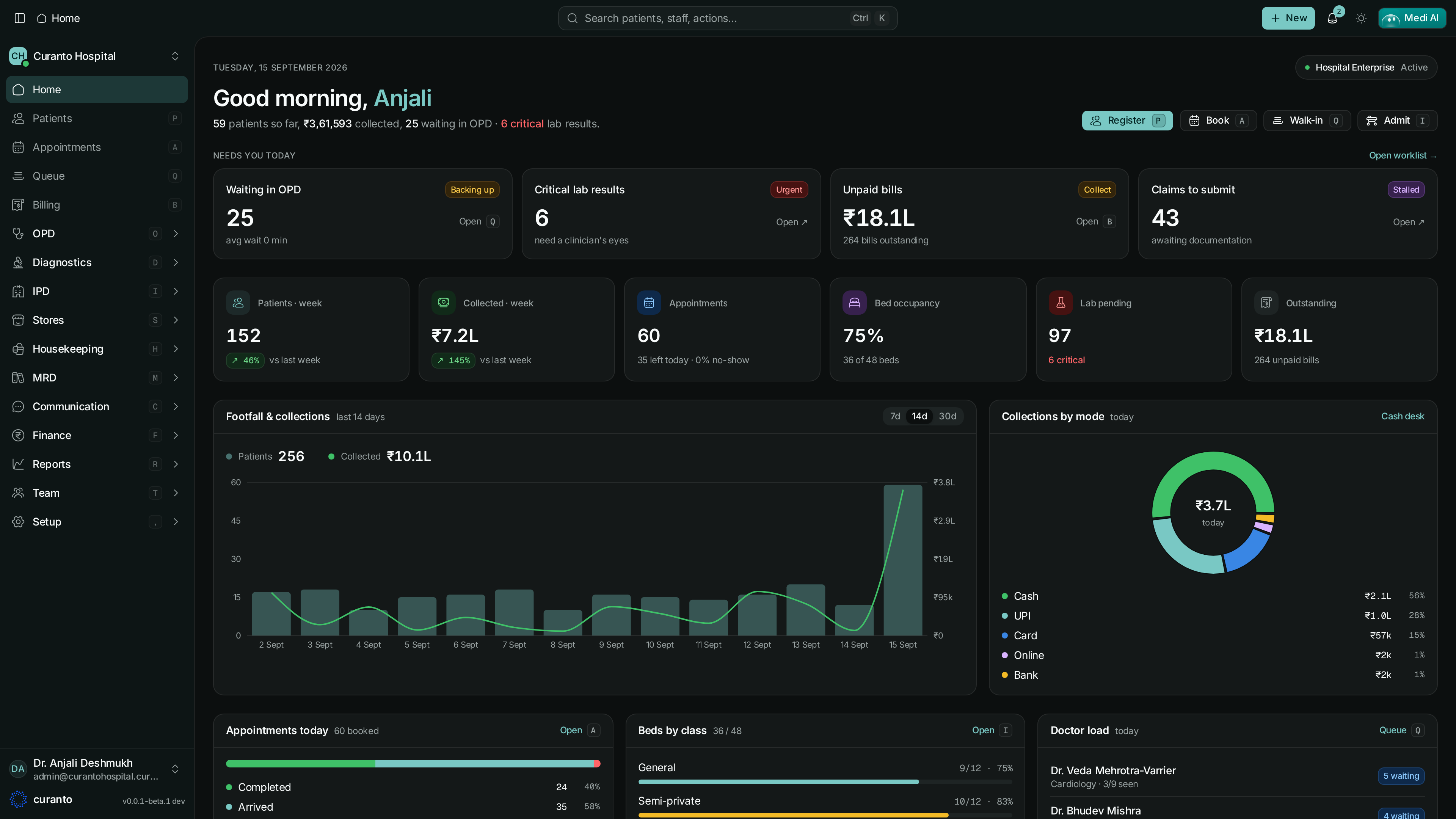
On the left, the kind of registration form still open at many Indian front desks: dozens of fields across six panels, and nothing that says what needs attention. On the right, Curanto's home screen on a busy day: the queue, the money, the beds and the lab, before anyone has to ask. Drag the handle.
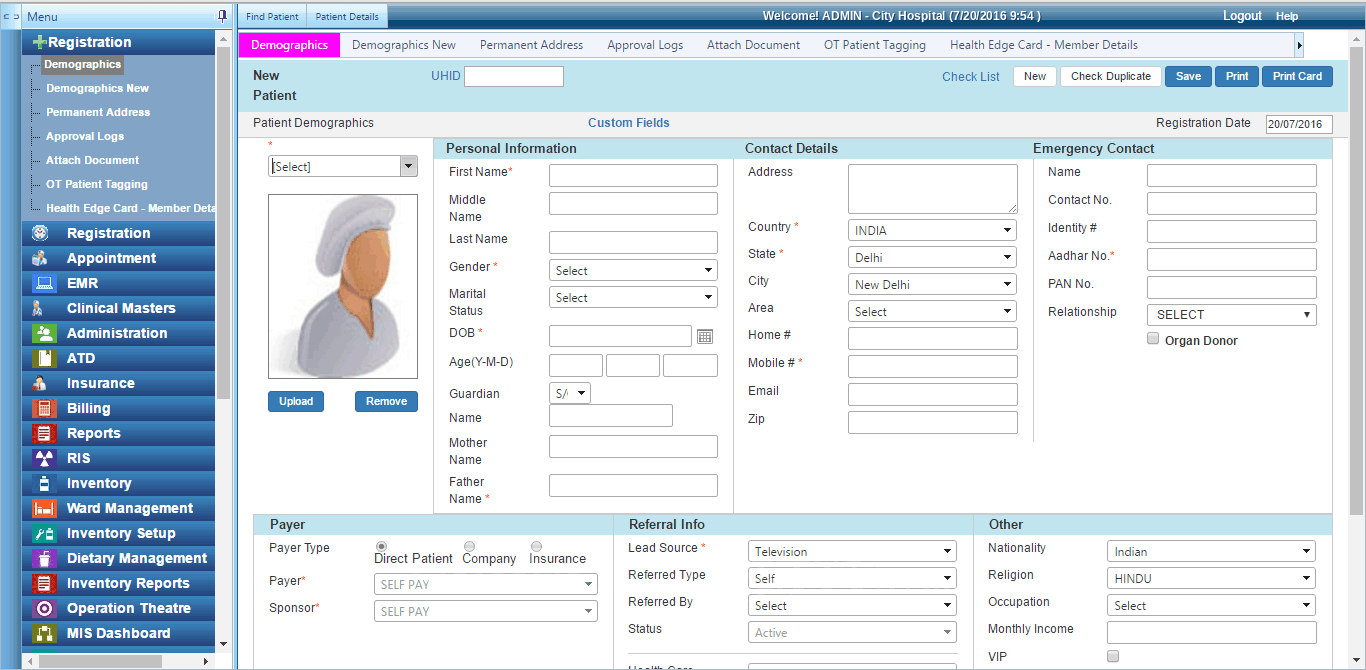 Before · legacy HIS
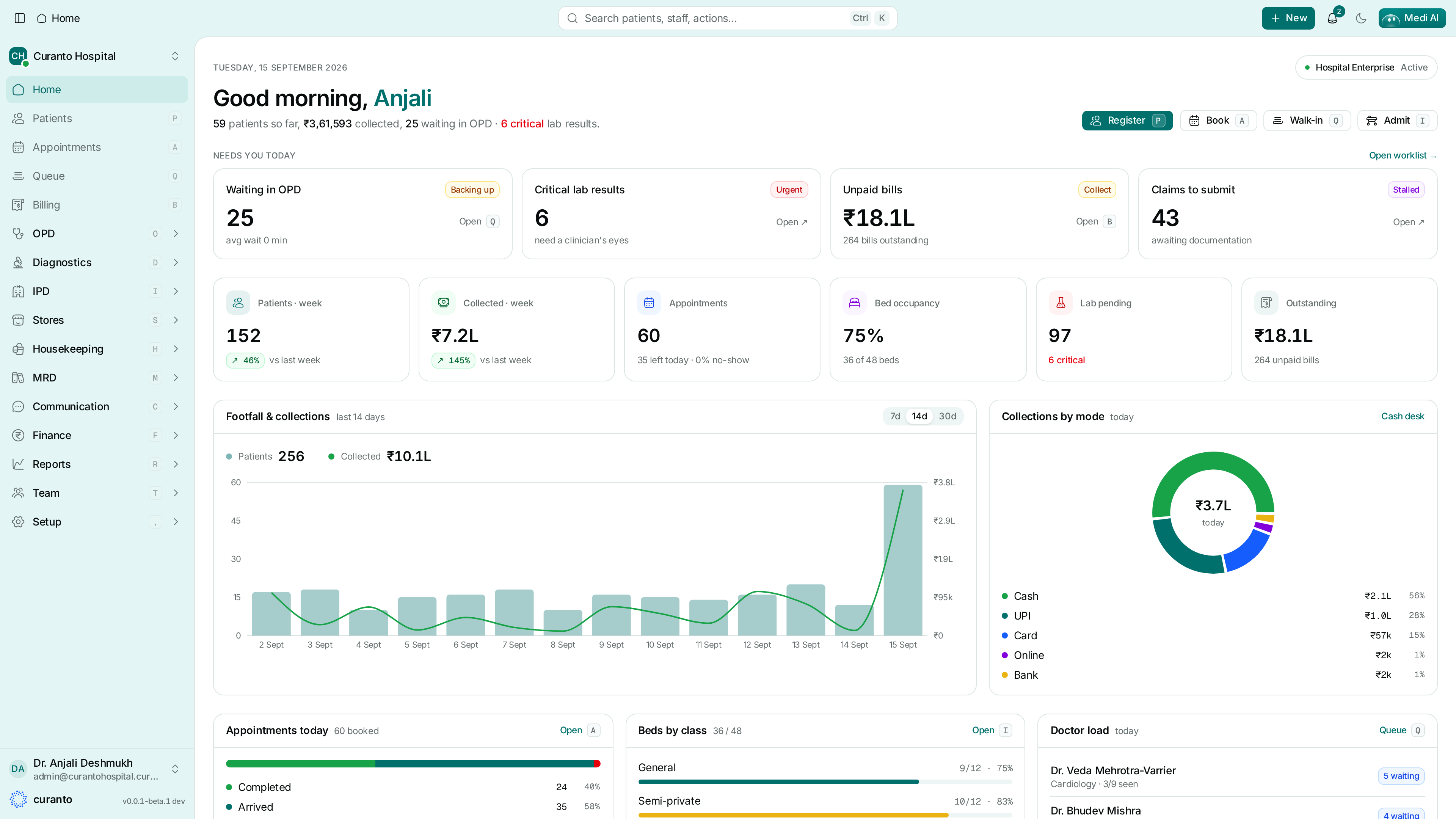 After · Curanto
Made for India
Built around how Indian hospitals are inspected, taxed and paid: the details that decide whether software survives its first audit.
Birth, death, OT, MLC, MTP with the second-RMP gate, PC-PNDT Form F and the Schedule H1 and X registers come from the record, not from a clerk on inspection eve.
Each department has a single-key shortcut, Cmd+K finds any patient, and the whole shell runs from the keyboard at the pace of a busy front desk.
HSN and SAC per item, inclusive and exclusive pricing, credit notes, GST reports and a Tally-ready export for your CA.
Razorpay UPI QR and payment links for patients; UPI AutoPay for your subscription. Cash, card and split payments reconcile to the rupee.
Hindi, Gujarati, Tamil, Telugu, Kannada, Malayalam, Bengali and Marathi alongside English, with the fonts to print them.
48 deterministic PDF templates: prescriptions, invoices, reports and registers render the same bytes every time, so what you signed is what the file holds.
Five workflows, one system
The day, from the desk to the day close. Every workflow below runs on one patient record, one bill and one audit trail. Switch a tab to see the actual screen.
Offline-resilient
Works when the internet does not. Forty-two percent of Indian doctors call connectivity a major barrier, and half of nurses report losing data during power cuts. Curanto was built for that reality: a reactive local cache on every device, a sync engine that reconciles in order, and a strict line between what may happen offline and what must wait for the server.
Synced
Every device holds the organisation's rows it is allowed to see, encrypted on disk.
Link drops
Registration, queue, notes, MAR and most daily work continue against the local copy.
Reconciling
Changes upload in order and conflicts resolve by rule. Money waits for the server, by design.
Seventy-five modules
Curanto is not a billing tool with add-ons. It is one system built as one, from the emergency desk to CSSD, so nothing needs integrating and nothing needs reconciling at month end.
Front office
01Clinical
02Inpatient
03Diagnostics
04Pharmacy & stores
05Billing & revenue
06And more
Emergency, blood bank, dialysis, CSSD, dietary, housekeeping, waste, equipment, ambulance, records, HR, expenses and Tally. Seventy-five modules in all.
Sample data. In the product every answer runs through your permissions and is audited.
Medi, the assistant
Ask the hospital a question. Get an answer, or an action. Medi runs 536 tools across every module, on web and mobile, using the same role, row-level security and audit path as the person asking. It cannot see or do anything you could not, and the administrator sees every rupee it costs.
How Medi stays inside the linesBuilt like infrastructure
Trust is not a feature. It is how the system is built. Hospitals hold the most sensitive data there is. Curanto treats tenancy, audit, money and offline as architecture, enforced at the database and on every device, not as settings that can be switched off.
Read the security overviewEvery row carries the organisation. Postgres row-level security, sync rules and the domain layer each enforce it. UI hiding is never the security.
An append-only, per-organisation audit log where each entry seals the one before it. Verified nightly; tampering is detectable, not deniable.
Medi acts with the asking user's permissions and audit trail, drafts stay drafts until a person signs, and an administrator can switch AI off for the organisation.
Invoice numbers, finalisation and audit appends are issued only by the server. Nothing about money is ever optimistic.
Crash reports and analytics are scrubbed at the SDK boundary with an allowlist of safe fields, so patient data never reaches them.
Nightly encrypted backups with restore drills and per-tenant export on request.
Pricing
Priced for the hospital India actually has. Seventy-seven percent of Indian private hospitals have fifty beds or fewer. Plans are priced by beds, with every login included and no per-user fees.
Priced by licensed beds. Every department, unlimited users and doctors.
Nursing Home
Nursing homes up to 30 beds
₹5,999/ month
₹71,988 billed yearly, + GST
Unlimited doctors · 30 beds · 1 branch
Get a demoHospital
Hospitals of 31 to 75 beds
₹9,999/ month
₹1,19,988 billed yearly, + GST
Unlimited doctors · 75 beds · 1 branch
Get a demoHospital Plus
Hospitals of 76 to 150 beds
₹17,999/ month
₹2,15,988 billed yearly, + GST
Unlimited doctors · 150 beds · 1 branch
Get a demoHospital Max
Hospitals of 151 to 300 beds
₹29,999/ month
₹3,59,988 billed yearly, + GST
Unlimited doctors · 300 beds · 1 branch
Get a demoEnterprise
Groups, chains and 300+ beds
Custom
Quoted per hospital
Unlimited doctors · unlimited beds · unlimited branches
Request a quotePriced per location. Unlimited staff logins.
Clinic Solo
A single doctor's clinic
₹999/ month
₹11,988 billed yearly, + GST
1 doctor · no IPD · 1 branch
Get a demoClinic Team
Clinics with up to three doctors
₹2,499/ month
₹29,988 billed yearly, + GST
3 doctors · no IPD · 1 branch
Get a demoPolyclinic & Day care
Polyclinics, day-care and dialysis centres
₹4,999/ month
₹59,988 billed yearly, + GST
10 doctors · 10 beds · 1 branch
Get a demoQuestions
The things every administrator asks first. Anything else, ask on the demo call or write to us.
Curanto is AI hospital management software built in India for clinics, nursing homes and hospitals. It covers the front desk, EMR, IPD, nursing, pharmacy, lab, radiology, billing with GST, insurance, records and 84 reports in one system, on web, desktop and mobile, with AI for the consultation note, prescription review, questions and actions across departments, and a morning business brief.
Six things today: an AI scribe that writes the consultation note in ten Indian languages, a one-click AI review of a prescription, Medi, an assistant that answers questions and takes actions across the hospital, a morning business brief, discharge summaries drafted from the chart and checked for omissions, and GST and drug-schedule answers taken from fixed rules.
Every hospital plan includes every AI feature under a monthly AI budget the administrator can see. Clinic plans add them per doctor with the AI scribe and Medi seat. There is no per-consultation or per-question charge.
No. The scribe drafts the note and marks every field it wrote; the doctor edits and signs. The prescription review is advisory and never blocks or edits a prescription. Discharge summaries stay drafts until a clinician finalises them. Drug interactions, tax rates, drug schedules and invoice numbers come from fixed rules and the server, not from a model.
The database is hosted in India. When someone uses an AI feature, the text it needs is sent to AI model providers through OpenRouter, which may process it outside India. The scribe removes names, phone numbers, Aadhaar numbers, dates of birth and emails from the transcript first, the prescription review sends no name or contact details, and the business brief sends totals only. Audio is never stored, and an administrator can switch AI off for the organisation.
Yes. Start the scribe when you open a consultation and talk to the patient as usual, in Hindi, Gujarati, Marathi, Tamil, Telugu, Bengali, Kannada, Malayalam, Punjabi or English. While you talk it suggests what to ask and what to examine. When you press Stop it writes the chief complaint, history, examination, assessment with ICD-10 codes, plan and follow-up into the note and prefills the prescription and lab orders. Every AI-written field is marked, your edits always win, and audio is never stored.
Yes. Curanto keeps an encrypted local copy of your organisation's data on each device. Registration, queue, notes and most daily work continue offline and sync when the connection returns. Money finalisation and invoice numbers are always issued by the server, so your books stay exact.
There is no self-serve signup. Every hospital is onboarded by the founding team: a walkthrough on your data, a migration plan and training. Request a demo and we reply within one working day.
In an Indian data centre, encrypted at rest and in transit, with nightly backups and tested restores. Each organisation's rows are isolated by Postgres row-level security, and the same rules govern what syncs to each device.
Curanto is built around the DPDP Act (consent records, data-principal requests, retention and anonymisation), generates the statutory registers hospitals are inspected on (birth, death, OT, MLC, MTP, PC-PNDT Form F, Schedule H1 and X) and issues GST-compliant invoices. ABDM integration is on the roadmap with the data model already in place.
Clinics start at 999 a month and hospitals at 5,999 a month for up to 30 beds, rising by bed count to 29,999 for 300 beds, on yearly billing and excluding GST. Monthly billing costs 20% more. There are no per-user fees, and Enterprise is quoted per hospital. See the pricing page for limits, add-ons and onboarding.
Yes. We import patients, masters, open admissions, stock and outstanding dues from your current system's exports or spreadsheets, and run in parallel for a fixed window before cutover.
Yes. The Curanto staff app for Android and iOS carries the nurse station, MAR, queue, approvals, the AI scribe and Medi, with the same permissions and audit as the web product.
A 30-minute walkthrough with a founder, on a sandbox loaded with a hospital like yours. No card, no self-serve signup, no pressure.
Or write to sales@curanto.in. We reply within one working day, Mon to Sat, 10:00 to 19:00 IST.